
Piety vs Pietism
“Piety” is a bad word in the minds of most these days. It is my observation that people outside of the church either see piety as a superficial religious mask used to hide bad character, or a rigid, cold, and austere adherence to religion that makes the pious person hard to be around. Even within the church, the word doesn’t fare much better. Some Christians dismiss piety as legalism and/or emotionalism, while others embrace it as a radical approach to the Christian life. All of these perspectives fundamentally misunderstand the nature and practice of piety.
Biblically understood, piety is an “ordinary” Christian life lived in communion with God through faith in Christ. It is characterized by faith, love, devotion, and delight in God. True piety protects the believer from two common dangers: cold orthodoxy, which is precise in doctrine but lacks heartfelt devotion, and pietism, an approach to the Christian life that chases devotion to God apart from the grace of God.
To better understand piety, we need to make a clear distinction between true piety and a spiritually dangerous approach to the Christian life known as pietism.
The Principle of Piety
What should we think of this misunderstood word? It comes from the Latin, pietas, which carries the ideas of duty and devotion. As the term began to be used in Christian theology, these concepts were united with faith and love.
In The Institutes of the Christian Religion John Calvin said piety is “that union of reverence and love to God which the knowledge of his benefits inspires.”[1] If you look up the word in the 1828 edition of Webster’s Dictionary, it says,
Piety in principle, is a compound of veneration or reverence of the Supreme Being and love of his character, or veneration accompanied with love; and piety in practice, is the exercise of these affections in obedience to his will and devotion to his service.[2]
In the simplest of terms, piety is a synonym for godliness. But that only takes us so far, since godliness itself is a word pregnant with meaning. There are many good definitions of piety in classic Christian literature, but for our study I offer the following summary: piety is a love for God that is grounded in Christ, expressed in devotion, and strengthened by grace.
Piety is not something we do, but something we believe and feel that moves us to live for God’s pleasure. It is an internal quality, a condition of the heart, that works itself out in our lives in practical ways.
Love for God
At its core, piety is not our obedience, but our “love for God that is grounded in Jesus Christ.” Our love for God is “reciprocal,” in that our love is a response to his love. John says, “We love because he first loved us.” (1 Jn. 4:19) And God’s love for us is demonstrated in sending his Son to die for our sins and give us eternal life (Jn. 3:16; Rom. 5:8). In Christ we are forgiven and reconciled to God, not only accepted, but adopted as his children (Rom. 814-17).
This makes our God the focus of piety. The pious are not navel-gazing, self-absorbed, experience-seekers, but self-denying, grace-dependent, God-seekers. We look to our “first love,” in whom we find love, and discover his mercy and grace which produce in us all joy and satisfaction. Piety is the soul’s delight in and devotion to our triune God.
A Christian’s love for God prioritizes God’s delight as the proper motivation in devotion. As Paul says, “So whether we are at home or away, we make it our aim to please him.”(3) The good pleasure of those we love moves us to act–to serve and sacrifice for their good pleasure. Their joy becomes our joy. In an even greater way, God’s joy gives us joy. In this way love is what animates a pious life. Love for God produces devotion to God.
“Piety is the soul’s delight in and devotion to our triune God.”
The Practice of Piety
If love for God moves us, piety is not duty, but devotion. Duty is an obligation we owe, love is the affection that compels us to give.
Expressed in Devotion
Our acts of devotion, or the practice of piety, are motivated by love for God, which creates a desire to honor him, reflect him, and walk with him in all of life.
Devotion is the expression of piety, but devotion is not just the exercise of duty. It is not conformity to rules, or the fulfillment of expectations. Devotion is an earnest loyalty stemming from authentic love. This reflects what we read so often in Scripture about God’s commands.
When God calls us to obey, he’s not interested in the modification and regulation of our behavior, but a faithful devotion that proceeds from love. Jesus referenced Deuteronomy and Leviticus when he said the greatest commandment is to “love the Lord your God with all your heart and with all your soul and with all your mind,” and the second greatest commandment is to “love your neighbor as yourself.” (Mt. 22:36–40) He also teaches us that true love for him leads to obedience (Jn. 14:15). [4]
For example, we are commanded to meditate on Scripture, and many Christians do so because they’re supposed to. It’s expected. While it is our duty to read, understand, and treasure God’s word, we shouldn’t open the Bible because we’re supposed to, but because we want to; because we delight in God and in his word.[5] We want to hear the voice of God in the pages of Scripture, experience the renewal of our minds, and receive grace that empowers us to live for his glory. Duty tells us what is required; delight compels us to do it. This is why God so often connects love and obedience and condemns acts of obedience when the heart isn’t behind it.[6]
This understanding of piety breaks down the artificial separation we create in our lives between the “secular” and the “sacred.” God’s will for us impacts all parts of all of our days. We draw near to God and walk with him, not just in a morning “quiet time” or corporate worship on the Lord’s Day, but also in our jobs, hobbies, chores, and rest. Paul makes this point in Colossians 3:17 when he says, “whatever you do, in word or deed, do everything in the name of the Lord Jesus, giving thanks to God the Father through him.”
There is nothing secular in a believer’s life, nothing that is separated from our walk with God. Not one part of your day is exempt from piety, because no part of your day is separate from God. Your thoughts, words, and actions; your responsibilities, privileges, and opportunities; your suffering, celebration, and mundane tasks; your ordinary and extraordinary circumstances are all opportunities to glorify and enjoy God. All of life is spiritual and lived in union with Christ. That is what this sermon series is all about.
“There is nothing secular in a believer’s life, nothing that is separated from our walk with God.”
Strengthened by Grace
Piety cannot be perfected in the life of a Christian. Like our faith, it can be strong or weak, and it can ebb and flow. It must be attended to, but it does not grow by our willpower. Piety grows by the grace of God through his “ordinary means.” This is why in our definition we say piety is “strengthened by grace.”
Piety is not the fruit of mustering up commitment and zeal. It comes by seeking and receiving God’s grace. His grace is communicated to us by the ordained “means” of the Scripture, the sacraments, and prayer–all of which beautifully come together for us when we gather for worship. God uses the Scripture to lead us to faith and to sanctify us progressively.[7] Prayer too is a means God uses for our growth in godliness.[8] Baptism is a means of grace we receive upon our public confession of Christ, and the Lord’s Supper is an ongoing source of strength for our faith.[9] The Baptist Catechism teaches this plainly in saying,
The outward and ordinary means whereby Christ communicateth to us the benefits of redemption are his ordinances, especially the word, baptism, the Lord’s supper, and prayer; all which means are made effectual to the elect for salvation.[10]
To grow spiritually means to grow in grace, by grace. And we can grow in grace. This is why Peter says we should “grow in the grace and knowledge of our Lord and Savior Jesus Christ,” and that grace and peace can be "multiplied" to us.[11]
Using the ordinary means of grace requires us to read, meditate on, believe, and obey the word of God. This knowledge of God and his will prepares us for all things and leads us in all things, as the Holy Spirit sanctifies us. Using the means of prayer calls us to take all things to God in praise, thanksgiving, confession, and petition. It means we come to worship on Sunday with the expectation that we will seek and find the grace we need.
While we can grow in grace and the practice of piety, we cannot experience a perfect piety. We will struggle and fail. Our best days, when experiencing an abundance of grace, are still marked by sin. But we do not despair or lose hope, because the grace that grows us is the grace that saves us. We walk with God not to gain his favor, but because we already have it in Christ. And God delights in our obedience, despite its imperfection, because it stems from faith and love, and is perfected by Christ who is our righteousness.
This is why piety produces humility, joy, and zeal. We are humbled by and rejoice in God’s grace which gives life and strength to walk in his ways and please him. We are “zealous for good works” because he has called us and equips us to walk in his ways.[12]
The Problem of Pietism
When we talk about piety, we want to be careful to distinguish between piety and pietism. These are two very different concepts with very similar names. Making matters worse is that pietism is as attractive as it is dangerous.
The Pietist Movement
Originally, “Pietism” was a 17th century movement among Lutherans in Germany that sought to correct the cold and lifeless version of Christianity that characterized many in the pulpit and the pew at the time. This condition is often called “dead orthodoxy.” The perception, and probably the reality, was that many leaders and members of the church confessed the truth of God in Christ, but were not living it out. With the spread of the gospel, the planting of churches, and the clear articulation of our faith in confessional standards, Christianity was ironically becoming formal and cold, leading to hypocrisy. The complaint was that such people were precise in doctrine, but not passionate in devotion. They were formally confessing Jesus as Lord, without being formed into his image.
If the Pietists identified a legitimate problem, their attempt to correct it created a new one. In seeking to recover and maintain a lively faith and nearness to God, they wound up distancing themselves from the very things God uses to give life to his people.
Because the ordinary means of grace had not apparently produced zeal and commitment in the church, they were seen as insufficient or ineffective. Because right doctrine had not revived the church, it was downgraded, if not held in suspicion as a potential problem itself. Regular obedience wasn’t enough either, because God, in the minds of the Pietists, is worth more than ordinary offerings. These were well-intentioned people who wound up emphasizing personal experience and radical forms of obedience that went beyond what God calls us to do in his word.
The Problem with Pietism Today
Pietism continues today, not as a movement, but as an approach to the Christian life that crops up in a variety of churches and traditions. If piety is a love for God that is grounded in Christ, expressed in devotion, and strengthened by grace, pietism is a commitment to obey and delight in God. That may sound good, but note the starting point of each. Piety is a love for God that is expressed in devotion, while pietism is a commitment to be devoted to God. They have different starting points, and different destinations.
The pietist looks more inward at himself than upward toward God. He focuses on himself to assess his condition and to compel himself to strive to do better. The more successful he is at conjuring up his version of godliness, the more confidence and joy he has before God. Performance is prioritized because pietism grows by one’s willpower.
Pietism chases after religious experience, not the grace of God, and calls for radical Christian living, either forbidding what God permits, or demanding what God does not. It commonly implements rigid rules, like how much Scripture must be read daily, how much time must be spent in prayer, and frequent, long fasting.
“Pietism seeks assurance of salvation and a closer walk with God by focusing on self and prioritizing the performance of radical discipline.”
Pietism doesn’t see all of life as holy and spiritual, but maintains a separation between the spiritual and secular. Worldly vocations are devalued while ministry and missions are elevated, as if a pastor glorifies God more in preaching the gospel than an orderly pushing a hospital gurney. This also leads to condemning practices God allows, like dancing, alcohol, or secular music. All of this generates a zeal untethered from true knowledge, and binds the conscience of the individual to the “doctrines and commandments of men.”
In pietism, the legitimacy and health of one’s faith is judged on their experience and efforts, which leads to pride and eventually despair. Despair comes in the end as pietism proves to be another man-centered effort to walk with God that cannot sanctify or bring a believer into closer communion with God.
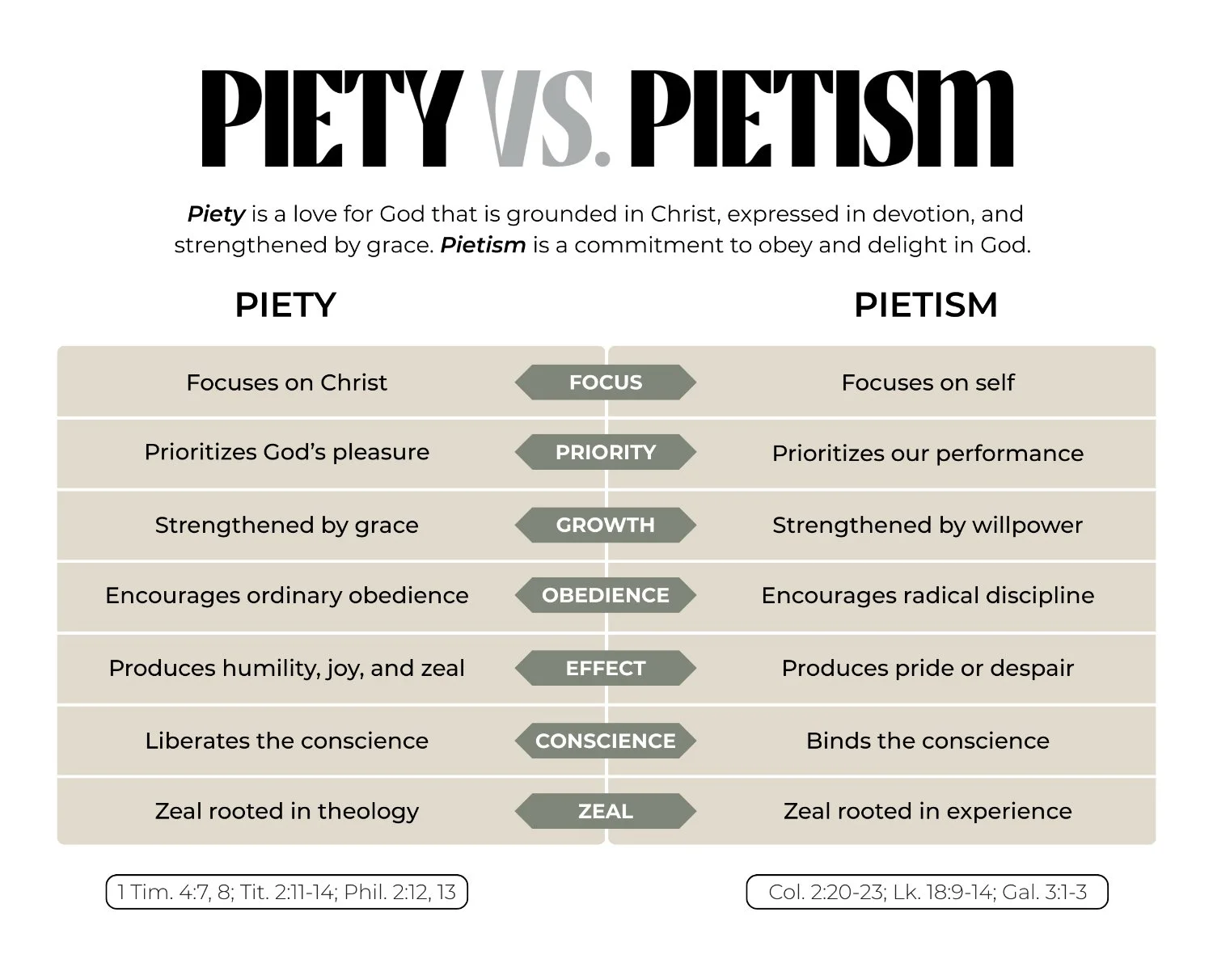
Both piety and pietism express the importance of devotion, but where it comes from, how it grows, and what it looks like is different for each. Pietism seeks assurance of salvation and a closer walk with God by focusing on self and prioritizing the performance of radical discipline. True piety, on the other hand, leads to assurance and a closer walk with God by looking to Christ, knowing that by his death our sins are forgiven, by his life we are declared righteous, and nothing can separate us from the love of God.
The Portrait of Piety and Pietism
Though piety and pietism may appear similar on the surface, they are driven by fundamentally different assumptions, demand different kinds of obedience, and produce very different fruit. The comparison below brings those differences into sharp focus.
1. John Calvin, Institutes of the Christian Religion, 1.2.1
2. Noah Webster, An American Dictionary of the English Language, 1828
3. 2 Cor. 5:9. Also see Col. 1:10; 1 Thess. 4:1; 2
4. For more Scripture on the connection between love and obedience, see Deut. 6:5, 6; 10:12, 13; Lev. 19:18; Jn 14:21-24; Rom. 13:10; Gal. 5:14; and 2 Jn. 6.
5. Ps. 1:2; 40:8; 112:1
6. 1 Sa. 15:22; Ps. 51:16, 17; Is. 29:13
7. Rom. 10:17; Jn. 17:17; 2 Thess, 2:13; 1 Pet 2:2
8. Jude 20; Jn. 17:17; Col. 1:9, 10; Phil 4:6, 7
9. Mt. 28:19, 20; Rom. 6:3, 4; 1 Cor. 10:16, 17; 11:23–26
10. Q. 93, The Baptist Catechism, 1695.
11. 2 Pet. 3:18; 1:2; 1 Pet. 1:2
12. Eph. 2:10; Tit. 2:14
13. The Second London Confession, 21.2
